The numbers stamped on a bolt head aren’t decoration — they tell you exactly how strong it is and, for stainless, what it’s made of. Misreading them is a common and costly procurement mistake. This guide explains the two systems you’ll meet in the UAE — strength classes for carbon/alloy steel and the A-class system for stainless — so you can specify with confidence.
Carbon & alloy steel: the strength-class system
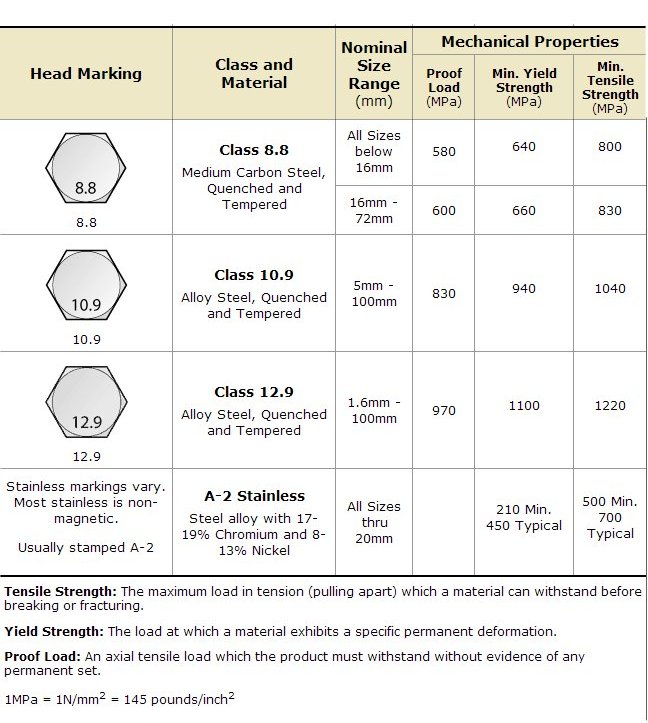
Carbon and alloy steel bolts use a two-number class such as 4.6, 8.8 or 10.9. The system encodes strength: the first number relates to the tensile strength and the second to the ratio of yield to tensile strength. In practice, higher numbers mean a stronger bolt.
| Class | Strength | Typical use |
| 4.6 | Low / general | Light-duty, general fixing |
| 8.8 | Medium-high | Structural steel, machinery — the common workhorse |
| 10.9 | High | Heavy structural, high-load connections |
| 12.9 | Very high | Precision, high-stress machinery (socket screws) |
Stainless steel: the A-class system (ISO 3506)
Stainless fasteners use a different code, e.g. A2-70 or A4-70. Here the letter-number describes the material and the final number the strength class:
- A2 — austenitic stainless, broadly equivalent to SS304.
- A4 — austenitic stainless with molybdenum, broadly equivalent to SS316 (marine grade).
- The number after the dash is the tensile strength class: 70 = 700 MPa, 80 = 800 MPa.
- So A4-70 = an SS316-type fastener in the 700 MPa strength class.
Strength vs corrosion: two separate decisions
This is the point most buyers miss. Strength class and corrosion resistance are independent choices. A high-strength 10.9 carbon bolt can still rust away outdoors; an A4-70 stainless bolt resists corrosion but is not as strong as 10.9. Decide the strength the load needs, then decide the material the environment needs — and specify both.
How to read a bolt head
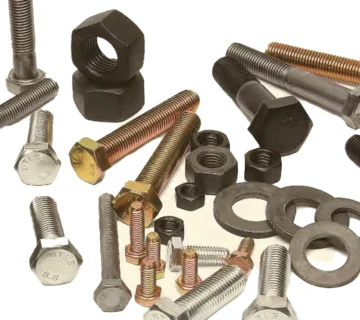
Carbon and alloy steel bolts are usually marked with the class (e.g. ‘8.8’) on the head. Stainless bolts are typically marked with the class and grade (e.g. ‘A4-70’ or ‘A2’). If a bolt is unmarked or the marking is inconsistent, treat its grade as unverified — a good reason to buy from a supplier who confirms grade.
Matching nuts to bolts
A nut must be strong enough that, if the joint is overloaded, the bolt yields before the nut strips. That means pairing each bolt class with a compatible nut grade. Mismatched pairings are a hidden failure risk; your supplier should always pair them correctly.
Choosing grades for UAE projects
- Pick the strength class for the load: 8.8 covers most structural work; 10.9 for heavy connections.
- Pick the material for the environment: HDG carbon for inland outdoor, A4/SS316 for coastal.
- Near the coast, prioritise A4-70 stainless even if a lower strength class would carry the load.
- Always confirm the nut grade matches the bolt.
Get correctly-graded fasteners in the UAE
Al Hafoof Hardware supplies fasteners across the full range of strength classes and stainless grades — 8.8, 10.9, A2-70, A4-70 and more — clearly marked and correctly paired, delivered across Dubai and the UAE. Tell us your load and environment and we’ll specify the right grade.
FAQs
It’s a strength class for carbon/alloy steel bolts. The first number relates to tensile strength and the second to yield; 8.8 is a common medium-high strength grade used widely in structural and machinery work.
Both are high-strength; 10.9 is stronger than 8.8, with higher tensile and yield strength. 10.9 is used for heavier structural and high-load connections, but is more notch-sensitive and usually requires appropriate plating/coating.
These are stainless fastener classes under ISO 3506. A2 is broadly SS304, A4 is broadly SS316; ’70’ indicates the tensile strength class (700 MPa). So A4-70 is a 700 MPa-class SS316 fastener.
Nuts must be rated to match or exceed the bolt so the bolt fails before the nut strips. Always pair a bolt with a compatible nut grade — your supplier can advise the correct pairing.
For strength, choose the class the load requires (e.g. 8.8). For corrosion in the UAE’s climate, choose the material — HDG for inland, A4/SS316 stainless for coastal — separately from the strength class.