Most roof leaks and loose sheets on UAE buildings trace back to the fasteners: the wrong type for the purlin, a drill point that burned out half-way, a sealing washer crushed by over-tightening, or zinc-plated screws rusting on a coastal roof. Choosing correctly is straightforward once you know the two main families — roofing bolts and self-drilling screws — and when each one fits.
This guide compares them, explains drill points and sealing washers, and covers the finishes that last in the Gulf climate.
Roofing bolt or self-drilling screw?
| Roofing bolt | Self-drilling screw | |
| How it fixes | Passes through a pre-drilled hole and is tightened with a nut — or hooks around the purlin | Drills its own hole and forms its own thread in one operation |
| Access needed | Usually both sides of the joint | One side only |
| Speed on site | Slower: drill, insert, fit the nut | Fast with a screw gun |
| Typical substrate | Angle, pipe or timber purlins; fibre-cement and corrugated GI sheet | Cold-formed steel purlins and girts, sandwich panels, steel framing |
| Best for | Hook-on fixing where purlins can’t be drilled, repairs and existing sheds | New metal roofs and cladding on steel structures |
Types of roofing bolt
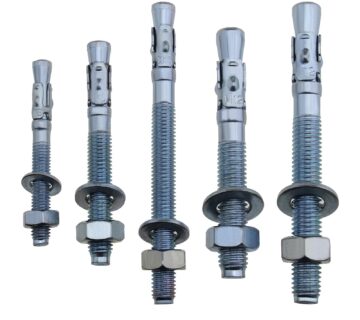
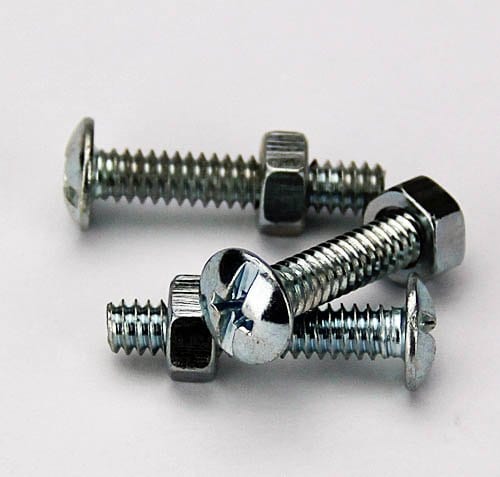
- Mushroom-head roofing bolt with square nut: the traditional sheet fixing in the region. The wide domed head spreads the load on the sheet and is used with a sealing washer. Al Hafoof supplies GI and MS roofing bolts from M6 to M12 and stainless steel roofing bolts for corrosive sites.
- J-bolts and hook bolts: hook around angle, pipe or channel purlins so the purlin doesn’t need drilling, and tighten from the top with a washer and nut.
Length matters: the bolt must pass through the sheet profile, any spacer and the purlin with enough thread left for the washer and nut.
Types of self-drilling screw
- Hex washer head: the standard roofing and cladding screw, usually fitted with a bonded EPDM sealing washer and driven with a hex socket.
- Pan or wafer head: for flashings, brackets and light framing where a low head is needed.
- Countersunk: for flush fixing.
- Wing-tip: for fixing timber or thicker material to steel — the wings ream a clearance hole, then break off.
Our hex head drilling screws (zinc-plated hardened carbon steel, lengths from 10 mm to 100 mm) and pan head drilling screws cover most roofing, cladding and framing jobs; see the full tapping screw range. For gypsum board on metal studs, see our drywall screw guide.
Drill points: match the steel thickness
The number on the drill point — written #2 to #5, or Tek 2 to Tek 5 — tells you how much steel the screw can drill through. A higher number means a longer drill flute and thicker steel. As a rough guide, a #4 point is made for steel up to about 6 mm and a #5 point for about 12.5 mm, while #2 and #3 points suit lighter gauges such as roof sheet and thin purlins.
Capacities differ between manufacturers, so check the figure on the box — and always count the total thickness of everything you are fixing through, not just the purlin. If the point is too short, it burns out before it breaks through: the screw spins, overheats and won’t tap.
Gauge is not the drill point
The screw gauge (for example 10g, 12g or 14g) is the diameter, and it decides holding strength. The drill point number decides drilling capacity. Specify both.
Sealing washers: the part that keeps water out
Roofing screws and bolts rely on a bonded sealing washer — a metal washer with a bonded EPDM rubber seal. Tighten until the EPDM is compressed and just starts to show at the edge of the metal washer. Under-tightened, the joint leaks; over-tightened, the rubber splits or squeezes out and the sheet can dimple. Under the UAE sun, use UV-stable EPDM — cheaper rubber hardens and cracks.
Sealing and flat washers are available from our washer range.
Crest or valley fixing?
On roofs, profiled sheets are normally fixed through the crests (ribs), so the fastener sits above the water running in the valleys. On wall cladding, fixing through the pans (valleys) is common because water runs straight down. Always follow the sheet manufacturer’s fixing pattern for spacing and side-lap stitching.
Galvanised, zinc-plated or stainless steel?
| Finish | Use it for | Watch out for |
| Zinc-plated (electro-galvanised) carbon steel | Indoor, sheltered or temporary works | A thin coating that rusts quickly outdoors |
| Galvanised (GI / hot-dip) | General outdoor roofing and cladding inland | Cut or damaged coating needs touching up |
| Stainless steel 304 / 316 | Coastal and marine sites, roofs near the sea, wash-down areas | 300-series stainless can’t drill steel — use bi-metal screws (stainless body, hardened carbon-steel drill tip) on steel purlins |
Avoid fixing stainless steel or aluminium sheet with zinc-plated or carbon-steel fasteners: in wet, salty conditions the small fastener corrodes quickly. For choosing a stainless grade near the coast, see SS304 vs SS316 fasteners.
Common mistakes on UAE roofs
- A drill point too short for the total steel thickness, so screws burn out.
- Running the screw gun too fast — heat dulls the point. Use the speed the screw maker recommends.
- Over-tightening and crushing the EPDM washer.
- Zinc-plated screws used outdoors or near the coast.
- Missing side-lap stitching screws, so sheets work loose and leak.
- Mixing fasteners and sheet materials that cause galvanic corrosion.
Fixing a roof or cladding package? Send us the sheet type and profile, purlin type and thickness, whether it’s roof or wall, the site location (inland or coastal) and quantities. We’ll recommend roofing bolts or self-drilling screws with matching sealing washers — in contractor packs where you need them. Request a quote or message us on WhatsApp.
Frequently asked questions
What size roofing bolt do I need?
M6 and M8 roofing bolts are the most common for sheet fixing; heavier fixings use M10 or M12. Choose a length that passes through the sheet profile, any spacer and the purlin, with enough thread for the washer and nut.
Can self-drilling screws replace roofing bolts?
On cold-formed steel purlins, yes — self-drilling screws are standard for new metal roofs. Where sheets fix to pipe or angle purlins that can’t be drilled, or where through-bolting is specified, roofing bolts or hook bolts are used.
Which drill point do I need for 3 mm purlins?
Add the sheet thickness to the purlin thickness and choose a point rated for at least that total. For around 3–4 mm of steel, a #3 or #4 point is typical, depending on the manufacturer’s rating printed on the box.
Do I need EPDM sealing washers?
Yes, for any fastener that passes through the weather surface of a roof or wall. The washer seals the hole; without it, water tracks down the fastener.
Stainless steel or galvanised screws near the coast?
Near the sea, use stainless steel 316 fasteners — bi-metal self-drilling screws where you are drilling into steel. Galvanised fasteners are a sound choice for inland roofs.
Do you supply contractor packs?
Yes. Drilling screws are available in retail and contractor packs, and roofing bolts in bulk. Tell us your quantities for a quote.